Neural Decision Tree for Bio-TinyML
- 2 minsOverview
In our work presented at the Biomedical Circuits and Systems Conference 2024, we introduce a Neural Decision Tree (NDT) — a hybrid architecture that combines the interpretability of decision trees with the end-to-end training capability of neural networks.
The motivation was simple:
Can we design a model that trains like a neural network, but runs like a decision tree?
The answer is yes — and it turns out to be particularly useful for TinyML healthcare systems.
The Problem
Deep Neural Networks achieve high accuracy, but they are:
- Computationally heavy
- Memory intensive
- Power hungry
- Often black-box
In TinyML healthcare deployments — especially battery-powered or rural diagnostic systems — inference cost directly translates to power consumption and device lifetime.
Decision Trees are lightweight and interpretable, but they rely on handcrafted split criteria and cannot be trained end-to-end using backpropagation.
We wanted both.
Neural Decision Tree (NDT)
The Neural Decision Tree replaces classical entropy-based split rules with learnable neural decision nodes, trained using backpropagation.
Unlike standard neural networks:
- Only one path is activated per input (tree-style routing)
- Computation scales linearly with depth
- Parameterization remains lightweight
- The structure retains interpretability
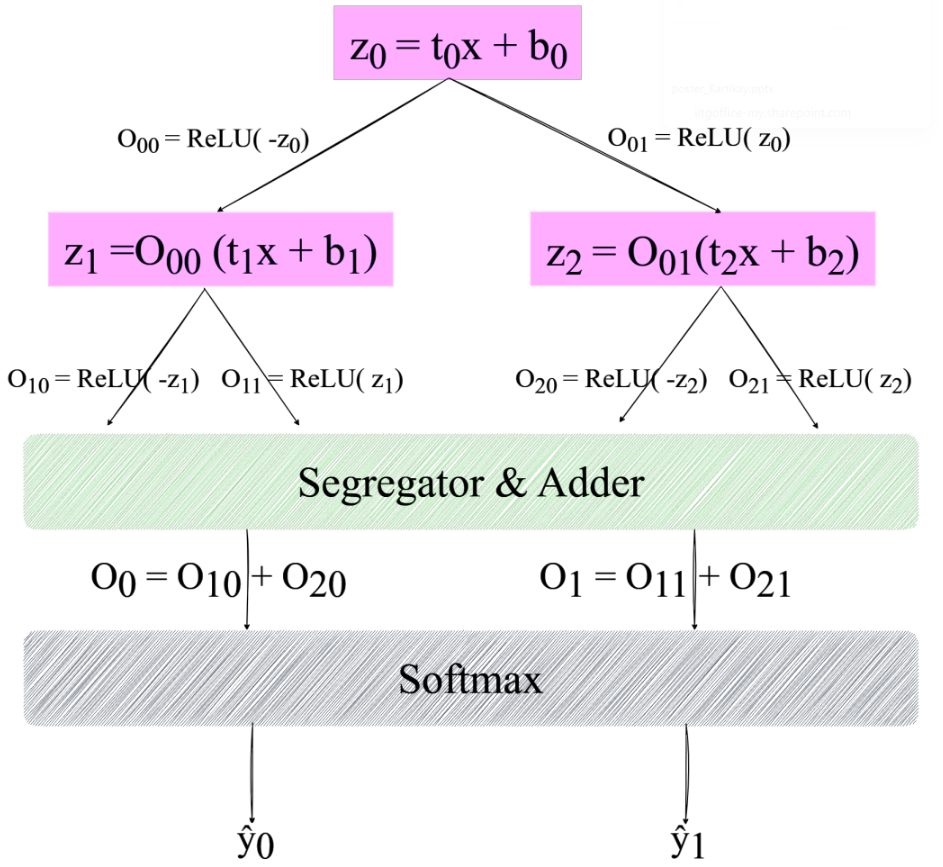
Neural Decision Tree architecture (depth = 2). Each node learns parameters while activating only one subtree per input.
This routing mechanism is the key to reducing compute without sacrificing non-linearity.
Does It Work?
We evaluated NDT on five biomedical datasets:
- Heart Disease
- Parkinson’s Disease
- Breast Cancer
- Cervical Cancer
- Epileptic Seizure Detection
Across tasks, NDT performs competitively with neural networks — often within a small margin — while using significantly fewer parameters.
But the real story is compute.
10× Reduction in Compute
Multiply-accumulate operations (MACs) determine inference cost in TinyML systems.
For example, on Epileptic Seizure detection:
- Neural Network: ~11277 MACs
- Neural Decision Tree: ~1073 MACs
That’s over 10× reduction in compute.
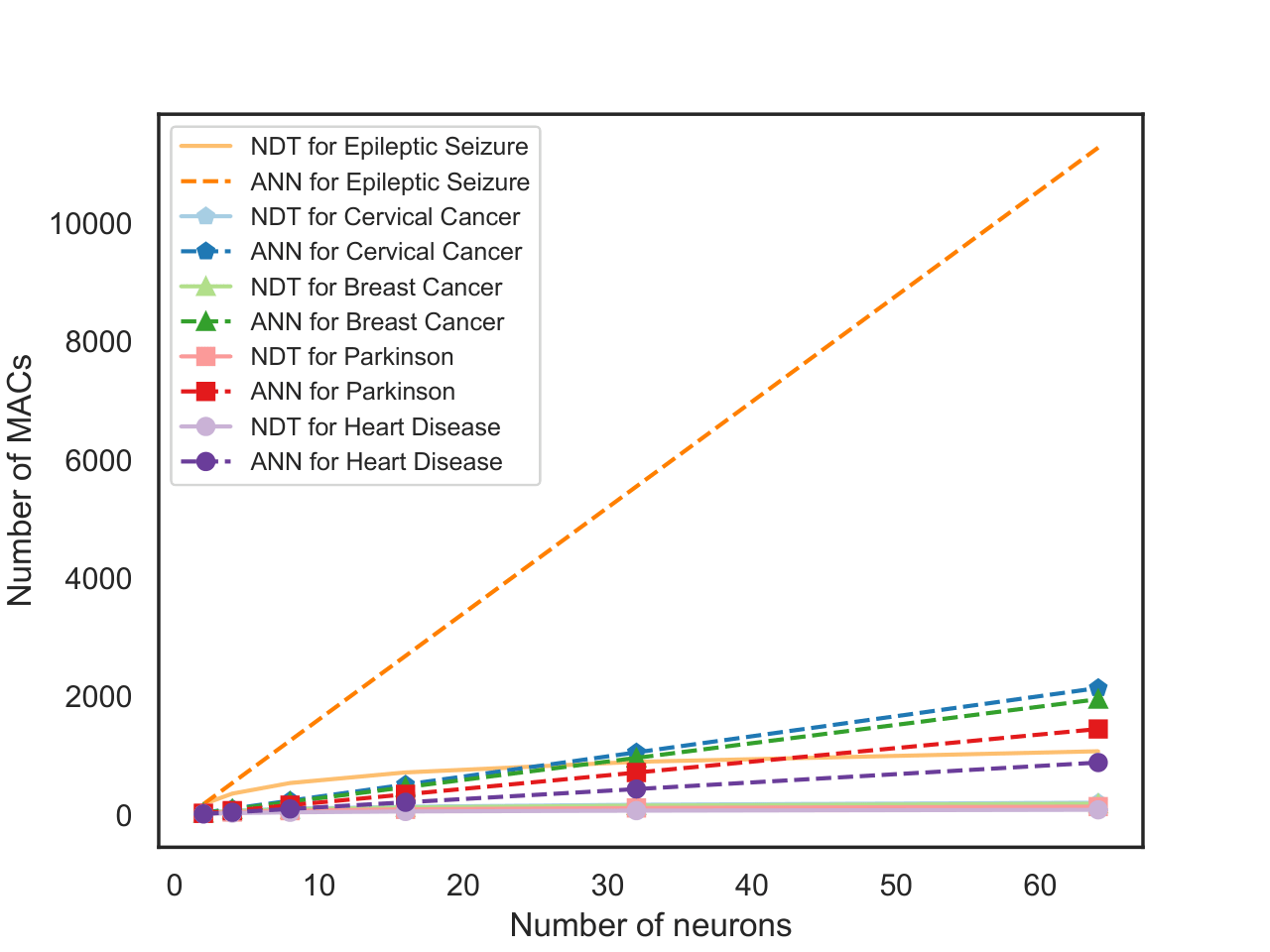
MAC comparison between Neural Networks and Neural Decision Trees across biomedical datasets.
The efficiency gain comes directly from the tree-style routing: only one subtree is active at each depth.
Why This Matters
Neural Decision Trees are:
- Backpropagation-trainable
- Interpretable
- Hardware-compatible
- TinyML-friendly
They are not meant to replace deep neural networks.
They are meant to enable machine learning where conventional neural networks are too costly.
Looking Ahead
This work opens several directions:
- Ensemble NDT architectures
- Multiclass extensions
- Regularization strategies
- Neuromorphic or spiking NDT variants
We see this as a foundational step toward efficient, interpretable edge intelligence for healthcare.